
BTi Sports Cash Out: When Should You Hold Your Bet or Cash Out?
In the 84th minute, the team you backed is leading 1-0. Your bet is almost over the finish line, and the match had been fairly comfortable up to that point. Then the opponent starts pushing the ball into the penalty area, winning corner after corner, while the leading team drops deep and can barely launch a counterattack. This is when many players face the biggest dilemma: should you hold the bet until the end or accept an early cash out?
Just a few minutes later, a penalty, a VAR decision, or an equalizer in stoppage time could completely change the outcome. However, cashing out based purely on emotion is not necessarily the best choice either. There are times when players close a bet too early simply because they see the opponent applying pressure for a few minutes, only to regret it when their original selection eventually wins.
The key point about BTi Sports cash out is not about finding the quickest possible exit. Its real value lies in setting a limit before the emotions of the match take over.
With the automatic cash out feature available for certain bets and markets, players can set a cash-out threshold in advance instead of having to constantly monitor the screen. The most sensible way to use it is not to “save every losing bet,” but to manage the capital already committed when the actual match situation no longer resembles the original plan.
Key Points to Remember
- Cash out means closing a bet before the event has been fully decided, with the cash-out value depending on the current status of the bet.
- Automatic cash out is most suitable when players have already determined an acceptable threshold, rather than making a decision during a tense moment in the match.
- Not every match, market, or moment will necessarily offer a cash-out option. Always check directly on the open bet slip.
- The cash-out value can change very quickly after a goal, penalty, VAR decision, red card, or major odds movement.
- Cash out does not turn a weak selection into a good one. It simply changes how the player manages the risk of an existing bet.
- You should not cash out a bet simply to immediately use the money to chase another bet.
What Exactly Is BTi Sports Cash Out?
BTi Sports cash out can be understood as closing an active bet before the final result of an event has been determined, provided that the bet is eligible for the cash-out option. When the cash out is successfully completed, the player receives the value displayed at the time of confirmation and is no longer dependent on the final result of the portion of the bet that has been closed.
This is an important point that many new players misunderstand.
Cash out is not the same as “cancelling a bet” to receive the original stake back. The offered value depends on the bet's probability of winning at that moment, odds movements, and what is happening during the event. A bet that is in a favorable position may have a cash-out value higher than the original stake. A bet that is in an unfavorable position may only have a value lower than the amount originally committed.
For example, suppose you placed a pre-match bet and the team you selected is leading after 75 minutes. The cash-out value at this point may be more attractive than it was when the match had just started. However, if the opponent equalizes or an unfavorable red card occurs, that value can change very quickly.
That is why players should view cash out as a position-management tool, not a “save my bet” button.
If you are unfamiliar with the market layout, you can first check how to use the BTi Sports 2026 lobby to understand how odds, markets, and bet slips are organized before exploring in-play decisions in greater detail.
What Is the Difference Between Regular and Automatic Cash Out?
Manual cash out requires the player to monitor the bet, check the value currently being offered, and actively confirm when they want to close the bet.
With automatic cash out, the idea is different in one important way: the player sets a threshold in advance if the bet interface supports this function. When the predetermined condition is met and the system is able to execute the request, the bet is processed without the player having to sit and wait for every small movement.
The main advantage is discipline.
Instead of making a decision in the 88th minute while under pressure, you have already established your limit before emotions start running high.
There is no option that is always better than the others. What matters is which approach best fits the plan you established beforehand.
Why Are Minutes 80–90 When Players Are Most Likely to Make the Wrong Decision?
The closing stages of a match are when emotions are most likely to override the original plan. When a bet is only a few minutes away from its outcome, players often overestimate the amount of time that has already passed and underestimate how quickly the match situation can suddenly change.
A team leading 1-0 in the 85th minute may appear very close to winning. But if they have just lost a centre-back, are being pushed deep, and are constantly facing set-piece situations, the final five minutes plus stoppage time can carry a completely different level of risk compared with the previous 80 minutes.
On the other hand, there are situations where the leading team drops deep but remains very well organized defensively. The opponent may have plenty of possession around the penalty area but create almost no clear chances. Cashing out immediately after seeing a significant possession imbalance may simply be a reaction to the visual impression of the match rather than an accurate assessment of the actual danger.
There is another issue in the final stages of a match: players start “counting the money” before the bet has actually settled.
They may already be imagining their balance increasing. When the opponent wins a corner, the feeling of losing money that they already consider theirs can make their decision more extreme. Some players cash out too early. Others refuse to cash out because they want to keep the entire expected profit.
Both can be emotional decisions.
When Is BTi Cash Out Worth Considering?
Cash out is worth considering when the evidence clearly weakens your original assessment or when the current value of the bet has reached the target you set before the match. You should not wait until you panic before looking for a reason to exit.
The first thing to consider is whether the nature of the match has changed.
You backed a team because you believed they controlled the midfield, but after half-time a key midfielder leaves the pitch and the balance of play changes. You backed the over because both teams were playing openly, but after the opening goal the leading team deliberately pulls the entire formation deeper. You backed the favorite on the handicap, but they lose a player and can no longer maintain their attacking pressure.
Changes like these directly affect the reasoning behind your original selection.
That is different from the opponent simply applying pressure for two consecutive minutes.
Four Signs to Check Before Cashing Out
- The structure of the match has clearly changed compared with when you placed the bet.
- A major event such as a red card, injury, penalty, or tactical change has weakened the original assumption behind your selection.
- The cash-out value has reached the range you previously decided was acceptable.
- The remaining risk of the bet is greater than the amount of exposure you are willing to accept.
If none of these factors apply and you simply want to exit because you feel nervous, the problem is likely that your original stake was too large.
A bet sized appropriately for your bankroll is generally much easier to manage calmly.
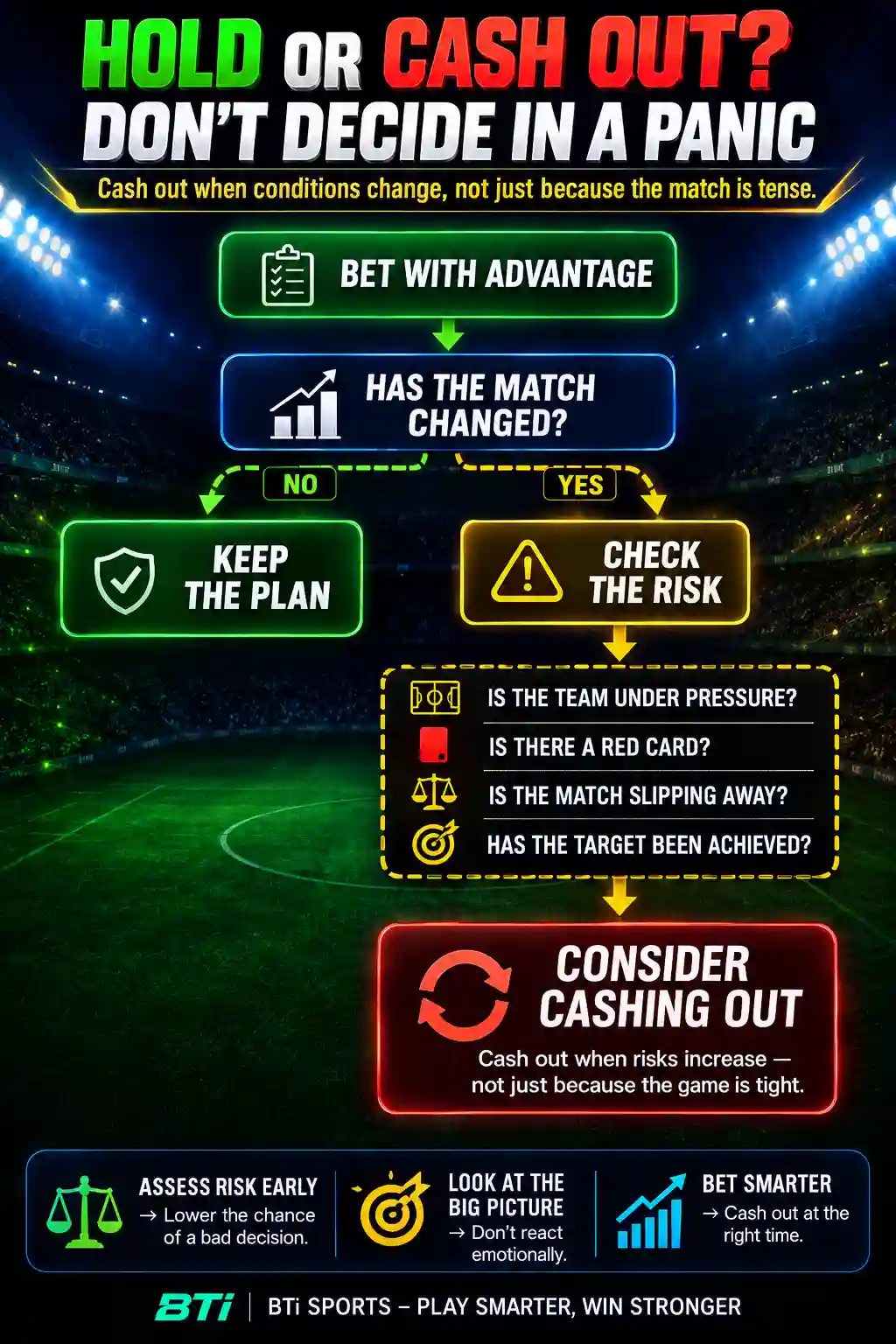
When to hold or cash out a BTi Sports bet
How Should Automatic Cash Out Be Set Up?
The best principle for setting up automatic cash out is to base your threshold on your bankroll plan, not greed. Players should decide in advance what amount is enough to close the position instead of continuously raising the target while the bet is moving in their favor.
If your goal is to reduce volatility, choosing a reasonable cash-out level from the beginning can help you make more consistent decisions. If you keep raising the threshold every time your team is winning, the purpose of the automatic feature is almost completely lost.
A practical process can follow four steps.
Step 1: Determine Why You Want to Use Automatic Cash Out
Some players want to lock in part of the result when their bet is moving in the right direction. Others want to limit their losses if the match turns against them. Some simply cannot follow all 90 minutes of a match.
These three objectives are different.
If you do not know from the beginning whether you want to protect profits or limit risk, it becomes difficult to set an appropriate threshold.
Step 2: Check Whether the Bet Supports Cash Out
You should not assume that every bet has the same BTi cash-out feature. Cash-out availability may depend on the match, market type, event status, and system conditions at that particular moment.
The safest approach is to open the active bet slip and check the available options directly.
If there is no corresponding button or setting, do not assume that the system is malfunctioning. The market may simply not support the feature at the time you check.
Step 3: Set Your Limit Before Your Emotions Change
This is the most important part.
If you have already determined a reasonable cash-out level before the match, stick to your plan. Continuously changing the threshold because you want a little more can bring you right back to the problem that automatic cash out is designed to reduce: emotional decision-making.
Step 4: Review the Bet Status After Setting It Up
Do not assume that once the setting is in place, everything will necessarily happen according to your preferred scenario. Market conditions can change, and the options available on a bet may not remain available at every moment of the match.
When possible, you should still check the status of the bet rather than treating the automatic feature as absolute protection.
Is Cash Out Really a Way to Protect Your Stake?
Cash out can help control the level of risk on a bet, but calling it a guaranteed way to protect your money would be misleading. When you close a bet early, you are exchanging the possibility of receiving the final result for a fixed value available at that moment.
In return, you give up any additional potential profit that could have been earned if your original selection eventually won in full.
It is a trade-off.
Not a magic solution.
The most useful bet protection tips still begin before the match: use an appropriate stake size, avoid putting too much capital into a single match, set a stopping point, and do not chase bets after a bad result.
Cash out is simply one part of that overall risk-management process.
For those who want to explore bankroll discipline in greater depth, see how to manage your sports betting bankroll. Although the original article uses the 2026 World Cup as its context, the principles of limiting stake allocation and controlling profits are still directly relevant when using cash out.
Do Not Turn Cash Out Into a Panic Button for the 90th Minute
There is a very familiar situation.
You backed the underdog. They are still covering the required handicap in the 82nd minute. The opponent begins applying pressure, the crowd becomes louder, and the commentators repeatedly mention the possibility of a goal. The player feels nervous and immediately starts thinking about cashing out.
But separate the feeling from the facts.
Is the opponent actually creating dangerous chances, or are they simply having more possession? How many times have they managed to get the ball into the six-yard box? Is the team you backed still maintaining its defensive structure? Are the recent shots coming from good positions, or are they simply long-range attempts?
Pressure does not always mean a goal is about to happen.
Conversely, a match that looks relatively calm but suddenly features a red card could be much more concerning.
Cashing out at the right time is not about predicting a goal in the 90th minute. It comes from recognizing that the probability you believed in when placing the bet has changed enough for the original decision to require another evaluation.
Quick Reference: Hold or Cash Out?
This table is not a formula for winning.
It is simply designed to help make decisions more structured.
Especially with live betting, it is easy for players to change their opinions after every phase of play. If you are not yet familiar with reading the market during a match, the guide on how to place live bets while a match is in progress can help you distinguish normal fluctuations from changes that genuinely deserve attention.
Why Can Setting a Cash-Out Threshold Too Close to the Maximum Profit Backfire?
If your cash-out target is almost equal to the maximum potential return of the bet, you are accepting most of the risk until the final stages while expecting the automatic feature to protect you during a very narrow window. At that point, much of the benefit of setting a limit in advance is significantly reduced.
For example, a bet has been moving favorably for more than 80 minutes. The player sets a very high cash-out threshold, thinking that they only need to wait a little longer.
But football can change quickly based on individual events.
An equalizer may arrive before the desired threshold is reached. When that happens, the cash-out value can change faster than the player's plan.
On the other hand, setting the threshold too low also has a downside. The bet may be closed as soon as it gains a small advantage, even though you were originally comfortable accepting a higher level of risk.
There is no single “magic number” that works for everyone.
The appropriate threshold depends on the size of the bet, your tolerance for fluctuations, and your individual bankroll-management objectives.
What Is the Difference Between Cashing Out a Profit and Cashing Out a Loss?
The two actions use the same button, but the psychology behind them is completely different.
When a bet is in a favorable position, players often find it difficult to cash out because they feel they are giving up potential additional profit. When a bet is going against them, they may instead hold on for too long because they do not want to accept a partial loss.
These are two opposing biases.
Cashing Out When the Bet Is in Profit
The goal is to exchange part of the potential upside for greater certainty at the current moment.
This can be worth considering when the current cash-out value has reached your target or when new developments have significantly increased the risk during the remaining minutes.
You should not cash out simply because you have just seen one dangerous attacking move.
Cashing Out When the Bet Is Going Against You
The goal is to accept a smaller loss rather than allowing the entire position to remain exposed to further risk.
This is often the more difficult decision psychologically. Players tend to think, “I’m already losing anyway, so I might as well keep it and see if it turns around.”
Sometimes the match really does turn around.
But that is not a good enough reason to hold every bet until the end.
The question to ask is: if you did not already have this bet, given what is happening now, would you still want to place the same selection?
If the answer is no, that is a signal worth considering.
BTi Cash Out Does Not Replace Reading the Live Market
Cash out only manages a bet that already exists; it does not analyze the match for you. To use the feature sensibly, players still need to understand odds, match conditions, Asian handicaps, over/under markets, and events that can change probabilities.
For example, suppose you are holding an over bet.
The score has not yet reached the required level, but the match remains open, both teams are continually finding space, and clear chances are being created. The value of the bet may be completely different from that of another match with the same scoreline where both teams have slowed the pace and are unwilling to take risks.
The score is the same.
The quality of the position is different.
Or suppose you are backing the favorite on the handicap. The favorite is leading but not by enough to cover the handicap. If they continue attacking aggressively, holding the bet has a different rationale from a situation where the team starts slowing the game down to protect its lead.
That is also why new players should understand the complete BTi Sports betting experience rather than focusing on a single feature and expecting it to solve every situation.
When Should You Not Cash Out?
There are three situations where I particularly do not recommend clicking cash out.
The first is cashing out out of panic. A dangerous attacking move causes the player to immediately abandon their original plan without evaluating the rest of the match.
The second is cashing out to use the money on another bet. The old bet is closed, the money is returned, and it is immediately placed on the opposite side or another match with a larger stake. This is no longer risk management; it is closer to chasing losses.
The third is cashing out because the original stake was too large compared with your bankroll. If a small fluctuation makes you unable to tolerate holding the bet, the main issue to fix next time is the stake size.
No feature can fix an overly aggressive bankroll plan.
Suppose You Have a VND 1 Million Bankroll: How Should You Use Cash Out Sensibly?
Suppose VND 1 million is the entire budget you have allocated for a betting session, not money intended for living expenses.
If a single bet represents only a small portion of your bankroll, you have more room to let your original analysis play out according to plan. If one bet represents a large portion of your bankroll, every fluctuation during the match creates significant pressure.
This is why you should not use cash out to justify over-betting.
The example below is not a fixed recommended percentage. It simply illustrates the relationship between bet size and the pressure involved in managing it:
A person using bet protection tips correctly does not ask, “How can I make sure I never lose a bet?” A more practical question is, “How much is each wrong decision allowed to affect my overall bankroll?”
That is where the difference lies.
Is Automatic Cash Out Better Than Monitoring Your Bet Manually?
Not always.
If you are closely following the match, understand the market, and are prepared to adjust your assessment when new information appears, manual management offers greater flexibility. You may recognize that a threshold you set earlier is no longer appropriate.
Automatic cash out is more useful when the goal is to reduce dependence on emotions or when you cannot monitor the match continuously.
For example, you may have several bets running at the same time. Switching between multiple matches can cause a decision to be delayed by several minutes. A predefined setting, if supported by the bet, can help keep your bankroll plan more consistent.
However, automatic does not mean smarter than the player.
The system only executes the conditions that have been set. If the original threshold is poorly chosen, the feature will simply execute that same poor plan.
How to Monitor BTi Bets on V9Bet Without Chasing Bets
Players can visit BTi Sports on V9Bet to monitor available markets and current bet status. Once you have placed a bet, it is useful to separate two activities: monitoring your open bets and looking for new betting opportunities.
Do not let the two become mixed together.
A common mistake is to be monitoring Bet A when you notice Live Bet B with changing odds. The player thinks B could “protect” A, so they place another bet. A few minutes later, both positions are unfavorable and the total risk has increased beyond what was originally expected.
BTi Sports Cash Out: A Practical Guide to Managing Your Bet
If your original goal is to reduce risk through cash out, opening two or three additional positions will often work against that goal.
On mobile, players who regularly check matches and bet slips can use the V9Bet app for Android or iOS. You can scan the QR code or choose the download option for your device. Android may require permission to install apps from external sources, while iOS may require you to confirm that the app is trusted under VPN & Device Management.
A Simple Process Before Enabling Automatic Cash Out
First, determine the maximum amount you are willing to lose on the bet. This decision should be made before the match becomes tense.
After placing the bet, check whether the market displays a cash-out or automatic cash-out option. If it does not, do not build your entire plan around the assumption that the feature will become available later.
If a suitable option is available, set the threshold according to your predetermined bankroll plan.
After that, avoid making changes simply because of a few minutes of favorable or unfavorable action. Only adjust the plan when new information changes the underlying assessment of the situation.
Finally, once the bet has been closed, treat that decision as the end of the position. Do not let regret over the fact that your team later went on to win immediately lead you into placing a new bet.
A risk-management decision does not become a bad decision simply because the subsequent result turned out to be more favorable.
Mistakes That Can Turn Cash Out Into a Tool for Chasing Bets
The most dangerous mistake is treating the cash-out amount as “new capital.”
Suppose you place a VND 500,000 bet. The match goes against you and you cash out for a partial amount. If that money is immediately used in full to place a live bet on the opposite side with the intention of “winning back what was just lost,” the original cash-out decision has almost completely lost its purpose as a way of protecting your bankroll.
You have simply transferred the risk from one bet to another.
Another mistake is repeatedly cashing out and re-entering the same match. A player sees the momentum change, closes Position A, and then five minutes later sees Team A applying pressure again and backs A at a new price. After an opponent's counterattack, they want to close the position again.
Each individual decision may sound reasonable when viewed in isolation over the previous few minutes. But the entire sequence shows that there is no longer a clear underlying assessment.
At that point, the best option is often to stop putting money on what you are watching.
You do not have to place a bet just because you are watching football.
Frequently Asked Questions
What Is BTi Sports Cash Out?
Cash out means closing an active bet before the event result has been fully determined, when the bet offers a cash-out option. The amount received depends on the status of the bet and market conditions at the time of processing. Cash out does not mean receiving your original stake back and does not guarantee that the player will avoid a loss.
How Does Automatic Cash Out Work?
In principle, automatic cash out allows a predefined threshold to be set on bets that support the feature. When the relevant conditions are met and the system is able to process the request, the bet is closed without the player having to click the button at exactly the right moment. Always check the active BTi bet interface directly, as you should not assume that every market offers the same options.
Can Every BTi Bet Be Cashed Out?
You should not assume so. Cash-out availability depends on the type of event, market, bet status, and the system options available at a specific moment. The most accurate way to check is to open the active bet. If the cash-out function is not displayed, you should not build your bankroll plan around the assumption that it will definitely appear later.
Is Cashing Out a Winning Bet Always Better Than Holding It Until the End?
No. Cashing out when a bet is in a favorable position allows you to exchange part of the potential profit for a more certain current value, but you also give up the additional return you could receive if the bet wins in full. The right decision depends on your predetermined objective, the remaining level of risk, and how the match is developing.
Should You Cash Out When Your Team Is Leading in the 85th Minute?
You cannot make that decision based only on the score and the minute of the match. You need to consider how the game is unfolding: is the leading team maintaining its defensive structure or being completely overwhelmed, is there a red card, and is the opponent creating clear chances or simply having more possession? If the cash-out value has already reached your predetermined target, that is also a factor worth considering.
Is Cash Out a Way to Win Back Money After Making the Wrong Call?
No. Cash out is not a loss-recovery tool. It is an option for closing an existing position at the value offered at that particular moment. After cashing out, using the entire amount received to chase another bet can cause the risk to return and may even increase it.
When Is Automatic Cash Out Most Useful?
It is most useful when a player has a clear plan in advance, wants to reduce emotional decision-making, or cannot monitor the match continuously. If the threshold is set purely out of a desire to maximize profit or is repeatedly changed according to emotions, the benefit of the automatic feature is significantly reduced.
Expert Conclusion
BTi Sports cash out is most valuable when used as a discipline tool, not as an emergency button in the 90th minute. When the bet and market support the feature, the ability to close a position early or set a predefined threshold can help players control the capital currently at risk instead of allowing emotions to take over during the most tense moments.
However, cash out cannot fix a poor selection, an excessively large stake, or the habit of chasing losses after a losing result.
To use the BTi cash-out feature sensibly, start with a plan before the match: how much of your bankroll does this bet represent, what level of risk are you willing to accept, what range is sufficient for you to close the position, and what changes in the match would make your original assessment no longer valid?
Once these limits are established, automatic cash out can genuinely serve its purpose. You do not need to turn the 88th minute into a battle between greed and fear.
If you follow BTi on V9Bet, check the available options directly on each bet before relying on the cash-out feature. And if the match is too difficult to read, the cash-out value is unsuitable, or you have already lost discipline, stopping is still a perfectly reasonable choice.
Protecting your bankroll does not always mean finding another bet.
Sometimes it means knowing when a position should end.
|
Approach |
Who Decides When |
Advantages |
Risks to Consider |
||||||
|
Hold until the end |
Do not cash out early |
Preserves the full potential outcome of the bet |
You may lose the advantage you currently have if the match turns around |
||||||
|
Manual cash out |
The player decides and clicks at the current moment |
Flexible according to the match situation |
Easily influenced by emotions |
||||||
|
Automatic cash out |
Based on a preset threshold when the feature is supported |
Reduces the need to monitor the match continuously |
An unreasonable threshold may cause the bet to be closed too early |
||||||
|
Situation |
Does Cashing Out Solve the Root Problem? |
More Appropriate Approach |
|||||||
|
Staking too much from the beginning |
No |
Reduce the stake size in advance |
|||||||
|
Your assessment changes because of a red card |
It can help |
Reassess the open position |
|||||||
|
Afraid of losing the profit currently shown on screen |
Not necessarily |
Compare it with your original objective |
|||||||
|
Losing the previous bet and wanting to use the cash-out amount to place another bet |
No |
Stop and do not chase losses |
|||||||
|
Unable to follow the match in full |
It can be useful |
Set a limit if the bet supports it |
|||||||
|
Match Development |
Consider Holding the Bet When |
Consider Cashing Out When |
|||||||
|
The team you backed is leading |
It is still controlling dangerous areas |
It is being pushed deep and the defensive structure is clearly deteriorating |
|||||||
|
The team you backed has just received a red card |
The match remains consistent with the type of bet you are holding |
The red card directly invalidates the original reasoning behind the bet |
|||||||
|
The opponent is applying pressure late in the match |
They mainly have possession but few clear-cut chances |
They are consistently creating clear chances inside the penalty area |
|||||||
|
The bet already has a good cash-out value |
The original objective has not yet been reached and the remaining risk is still acceptable |
The value has reached your predetermined cash-out threshold |
|||||||
|
You are starting to feel unsettled |
The stake is small and you can still assess the match objectively |
Your emotions are preventing you from following your plan |
|||||||
|
Bet Size Relative to Your Budget |
Common Psychological Response |
Main Issue |
|||||||
|
Small |
Easier to follow your plan |
You still need to choose bets with a solid basis |
|||||||
|
Medium |
You start paying close attention to live fluctuations |
A clear limit should be set before the match |
|||||||
|
Too large |
Every play creates additional pressure |
The stake size itself is the issue that needs to be addressed |
|||||||